Understanding Sarkar (2002)

This is the PDF version of Understanding Sarkar. If you wish to order a print copy you can do it here

Understanding Sarkar: The Indian Episteme, Macrohistory and Transformative Knowledge

By Sohail Inayatullah
Leiden, Brill, 2002

Sohail Inayatullah takes us on a journey through Indian philosophy, grand theory and macrohistory. We understand and appreciate Indian cyclical and spiral theories of history and their epistemological context. From other civilizations, we explore the stages and mechanisms of social change as developed by seminal thinkers such as Ssu-Ma Ch’ien, Ibn Khaldun, Giambattista Vico, George Wilhelm Friedrick Hegel, Oswald Spengler, Pitirim Sorokin, Michel Foucault and many others. They are invited to a multi-civilizational dialogue on the nature of agency and structure and the ways to escape from the patterns of history.

But the journey is centred on P.R. Sarkar, the controversial Indian philosopher, guru and activist. While Sarkar passed away in 1990, his work, his social movements, and his vision of the future remain ever alive. Inayatullah brings us closer to the heart and head of this giant luminary. Through Understanding Sarkar, we gain insight into Indian philosophy, comparative social theory, and the ways in which knowledge can transform and liberate.

Length: 368 pages

After payment, you will receive an email with the download link. If the email does not appear in your inbox, please check your spam folder.

Comments on Understanding Sarkar

The next generation of South Asians will consider themselves fortunate that scholars like Sohail Inayatullah have helped to keep open a humane and plural vision of the future for them.

Dr. Ashis Nandy is the director of the Center of the Study of Developing Societies, Delhi. Author of The Intimate Enemy and Traditions, Tyranny and Utopias.

It’s a superb book. Deeply inspiring and provocative. The Sarkar-Inayatullah combination makes a very good reading indeed. Inayatullah introduces the fascinating world – in time, in space, and in social space – of P.R. Sarkar.

Johan Galtung, President of Transcend: A Peace and Development Network and author of over seventy books on peace studies, futures studies, international relations, Gandhi, and social theory. Formerly, Professor of Peace, Political Science and Sociology at the Universities of Bern, Saarland, Hawaii and Witten-Herdecke.

Dr. Sohail Inayatullah is the leading example of a new generation of global thinkers, actors and visionaries. While firmly attached to and informed by the culture into which he was born and passionately and yet rationally committed to facilitating the future of South Asia, Sohail Inayatullah is also a global it is not too much to say, cosmic figure as well, carrying in his very person the tensions and hopes of a future which is at the same time both local and global.

James Dator is a professor of political science and director of the Hawaii Research Center for Futures Studies, University of Hawaii. Secretary-General and President of the World Futures Studies Federation, 1982-1990.

In addition to the service he is rendering by bringing to a wider audience the thoughts of a very important thinker, Sohail Inayatullah provides an extraordinary contribution to social theory with an unusual combination of analytic rigor and boundary-challenging imagination.

Professor Michael Shapiro, University of Hawaii, is the author of numerous books on political and social theory, including Reading the Postmodern Polity, Reading ‘Adam Smith’, Violent Cartographies and Cinematic Political Thought, For Moral Ambiguity: National Culture and the Politics of the Family 2001.

In this scholarly and inspiring work, Sohail Inayatullah brings to life the contributions of the remarkable Indian visionary, theorist, and social activist Prabhat Rainjan Sarkar. Skillfully blending his understanding of both Eastern and Western scholarly traditions, Inayatullah looks at history from a non-eurocentric perspective that also takes into account the thinking of some of the best known Western macrohistorians. This book is not only highly instructive; it also never loses sight of what Sarkar called neo-humanism – the consciousness that we are part of an interconnected whole and that a good society is one that manages to represent harmoniously the spiritual needs of its individuals.

Riane Eisler, author of The Chalice & The Blade, Sacred Pleasure, and Tomorrow’s Children.

Sarkar’s writings on historical processes offer a refreshing alternative to the orthodox interpretations of Toynbee, Hegel and Marx. He makes Samuel Huntington’s Clash of Civilizations seem parochial in comparison. Dr. Inayatullah skillfully weaves Sarkar’s comprehensive overview of cultural life-cycles into a coherent whole, through which the full sweep and scope of the fundamental forces that shape history can be rendered. Despite the magnitude of the canvas upon he paints, his is a work of systematic and focused scholarship. This book should be required reading for anyone looking to understand macrotheories of social change from a non-eurocentric, holistic, and synergistic perspective.

Dr Tim Dolan is an Associate Professor of Political Science at Southern Oregon University and Director of the Master in Management Program.

Sohail Inayatullah is the world’s leading scholar of Sarkar’s thought. His latest book, Understanding Sarkar, is sweeping in scope – quite literally a philosophical tour de force. By contrasting Sarkar’s ideas to some of the greatest minds in human history, Inayatullah has achieved a remarkable philosophical integration that is both breathtaking in its vision and relevant in its possibilities for creating societal change. Indeed, if you want a better grasp of Sarkar’s comprehensive worldview, I can think of no better source than Inayatullah. Brilliant.

Roar Bjonnes, writer and former editor of Prout Journal and Common Future

Dr. Sohail Inayatullah’s book offers an excellent entry point for those wanting to explore the fascinating and challenging ideas of P. R. Sarkar. At the same time, Understanding Sarkar provides those who have studied Sarkar with wonderful new ways of seeing and connecting the vast expanses of his works. We owe much to Dr. Inayatullah for this splendid effort.

Craig Runde is the director of new program development at Eckerd College, St. Petersburg, Florida.

In a time when “global” is equated with “western”, Sohail Inayatullah takes us through the door of Indian thinking to a worldview that is global in the true sense of the word. Going beyond naive Western idolization of Asian philosophies and avoiding the pitfalls of dogmatic, sometimes fanatic, adherence to tradition faith characteristic to many Eastern mentalities, Inayatullah examines P.R. Sarkar’s world in pursuit of a universality that is yet to be realized within the potential of human civilization. Those wishing freedom from culturally ingrained mental habits should consider this work as essential reading.

Dr. Partow Izadi, senior scientist in evolutionary futures, global education and systems theory, University of Lapland, Finland.

This is a companion volume to Inayatullah and Galtung’s masterly synthesis of macrohistory and macrohistorians, that includes P R Sarkar. Here the practice as well as the theory of Sarkar enters the grand sweep, enriching and legitimating the story. Their respective models have elements in common but few contain all Sarkar’s elements of spiritual practice, humanity, and humility – even if potentially ferocious. He lived, fought and spread his theory into a movement. Isolated perhaps from the writings of the other great minds, Sarkar seems to have an uncanny understanding of the emerging insights of genetics on our social behavior (evolutionary psychology or neo-Darwinism) and of social construction.

Alan Fricker, President, Sustainable Futures Trust, Wellington, New Zealand

Beautiful! A great work.

Dada Maheshvarananda, Author of After Capitalism and Neo-Humanist Ecology

Previously, Dr. Inayatullah’s co-authored Macrohistory and Macrohistorians wove the warp and weft of philosophical perspectives throughout the course of history. Now, Sohail Inayatullah provides a provocative look at macrohistorical trends from the standpoint of a renowned Eastern philosopher and social critic, P.R. Sarkar, whose impassioned views emote feelings of the forgotten masses.

Sarkar’s wide-ranging views, aptly portrayed by the author, tend to force reconsideration of Western, capitalistic, entrepreneurial, materialistic, secular, scientific and political engrained mindsets. Dr. Inayatullah’s presentation piques realization of the self-centered and smug arrogance that often underpins Western views. Sarkar’s wisdom of the Eastern philosophical perspective, will send minds racing. Grasping the salience of diverse views is certain to regird a searching of the readers’ own consciousness. Readers may begin pondering engrained cultural mindsets, guiding philosophies, and the Great Issues posed by the book. In the process, readers may come to better know themselves.

The author’s marvelous ability draws out and details deeds, developments and discourse that frames the Great Issues of civilization from the perspective of one of India’s renown philosophers.

Privileged elites in all of humanity’s innumerable dimensions almost certainly will be provoked into assessing their own cultural mindsets. Perspectives consciously established in one’s mind, will compel – perhaps for the first time – consideration of unconscious attitudes and beliefs.

Graham Molitor, President, Public Policy Forecasting, and Vice President & Legal Counsel, World Future Society.
Peace Futures (PDFs)

List of available PDFs from Metafuture.org


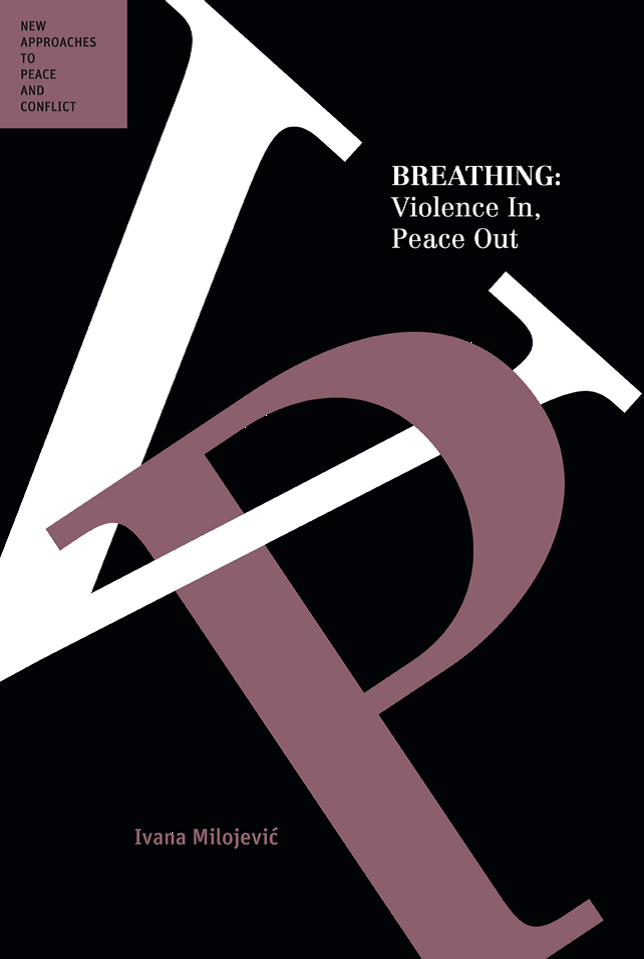
Milojević, I. “Introduction.Breathing: Violence In, Peace Out (1-7), New Approaches to Peace and Conflict Series (Brisbane, University of Queensland Press, 2013), 1-7.
Milojević, I.“Making Peace: Kosovo/a and Serbia.Journal of Futures Studies (Vol. 13, No. 2, 2008), 1-11.
Milojević, I.“Gender, Militarism and the View of the Future: Students’ Views on the Introduction of the Civilian Service in Serbia.Journal of Peace Education (Vol. 5, No. 2, 2008), 175-191 (with Slobodanka Markov).
Milojević, I.“Reconciling Funny and Permissible: Can We Develop Non-violent Humour?Social Alternatives (Vol. 25, No. 1, 2006), 67-70.
Milojević, I.“Gender, Peace and Terrestrial Futures: Alternatives to Terrorism and War.Ljudska Bezbednost (Human Security), Thematic Issue: Gender and Human Security (Vol. 3, No. 2, 2005), 85-110. Previously published in Journal of Futures Studies, (Vol. 6, No. 3, 2002), 21–45.
Milojević, I.“Gender and the 1999 War In and Around Kosovo.Social Alternatives (Vol. 22, No. 2, 2003), 28–36.

BREATHING: Violence In, Peace Out (Book Info, 2013)

Authored by Ivana Milojević

University of Queensland Press | Non-fiction/Academic | ISBN: 978 0 7022 4969 3 | October 2013 | C Format Paperback | 304pp |


Table of Contents

Introduction

Chapter 1. Communism, utopia: the personal is political

  • Salvation
  • Progress and regress
  • Raising of children and worldview
  • Othering
  • The failure and the evolution of utopia

Chapter 2. War, dystopia: the holy trinity of militarism, imperialism and nationalism

  • Knives, guns and beyond
  • Bellicose fantasies of glory
  • ‘We’ of the ‘lesser’ people
  • Nation-states and nationalisms

Chapter 3. Feminism, eutopia: challenging patriarchy and androcratic masculinities

  • Mothers and soldiers
  • Masculinity wars
  • Men as violence subjects and objects
  • Men’s expendable lives
  • Feminist eutopia: alternative peace-oriented masculinities and femininities

Chapter 4. Living trauma, eupsychia: the political is personal

  • Horizontal and vertical breakdowns
  • Concentric cycles and ripple effects
  • Past and present traumas
  • Post-traumatic growth

Epilogue

ABOUT THE SERIES

UQPs New Approaches to Peace and Conflict series builds on the wisdom of the first wave of peace researchers while addressing important 21st century challenges to peace, human rights and sustainable development. The series publishes new theory, new research and new strategies for effective peacebuilding and the transformation of violent conflict. It challenges orthodox perspectives on development, conflict transformation and peacebuilding within an ethical framework of doing no harm while doing good.

Purchase BREATHING: Violence In, Peace Out through University of Queensland Press or Amazon.com


University of Stellenbosch Workshop 2015

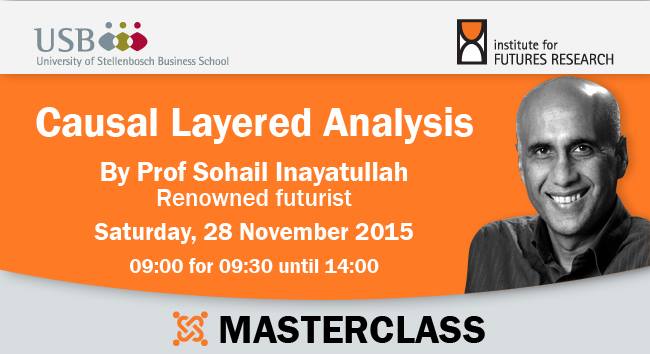
The Institute for Futures Research (IFR) at the University of Stellenbosch Business School (USB) is delighted to invite you to a Masterclass by renowned futurist Prof Sohail Inayatullah.

Since the establishment of IFR 41 years ago, we have hosted some of the world’s leading futurists, and we are proud to present this dynamic and interactive event with one of the leading figures in futures research today.

Prof Inayatullah gained global prominence through Causal Layered Analysis, a transformative theory of knowledge that has been developed over the past 25 years and which is used throughout the world in a number of settings.

Book now. We look forward to seeing you there.

Date: Saturday, 28 November 2015.
Venue: Lecture Hall 2058, USB main building, Bellville Park Campus, Tyger Valley business district, northern Cape Town

The Institute for Futures ResearchUniversity of Stellenbosch Business SchoolCape Town, South Africa

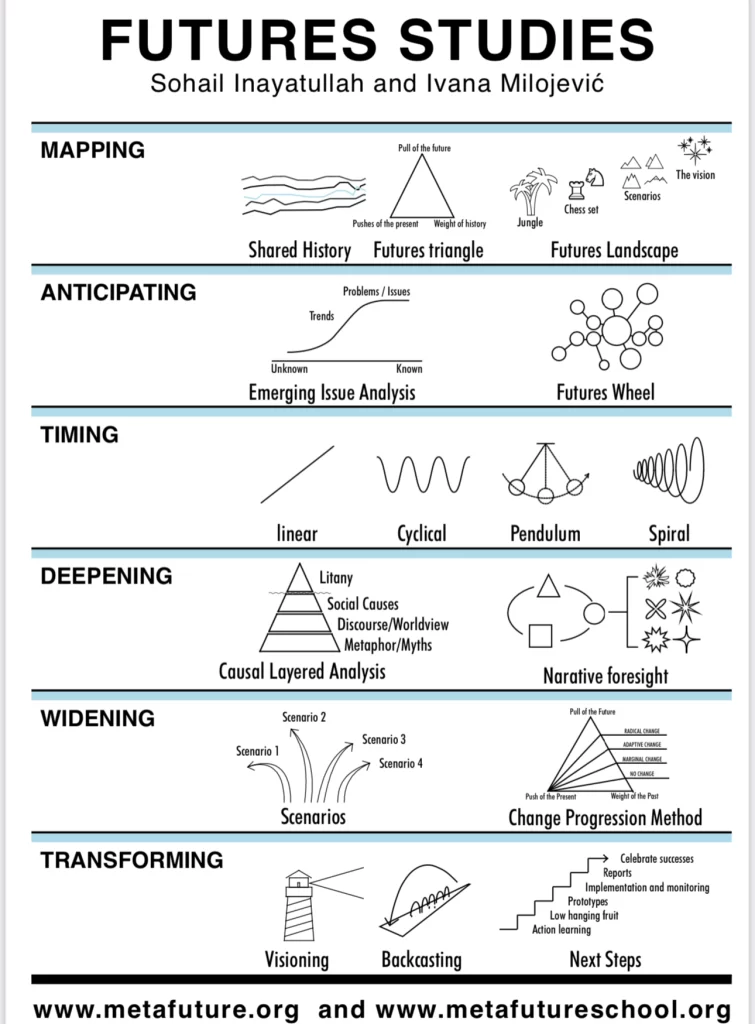
All the components of six pillars which are the foundation of futures thinking are displayed in this study

“Six Pillars” Model Summarised

Mapping the Present and the Future - through methods and tools such as the futures triangle and the futures landscape.

Anticipating the Future - through methods such as emerging issues analysis and the futures wheel.

Timing the Future - understanding the grand patterns of change, macrohistory and macrofutures.

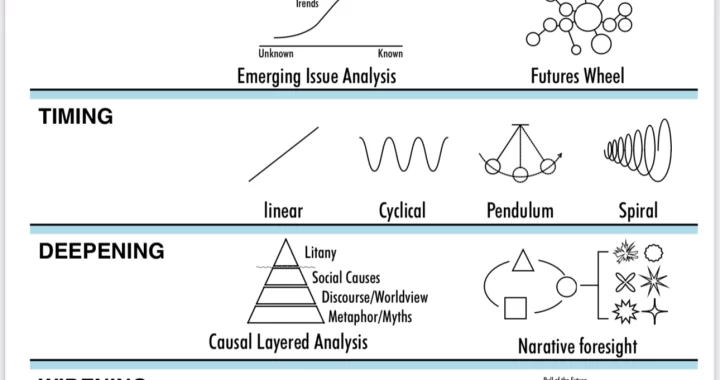
Deepening the Future - through methods such as causal layered analysis and multiple selves theory.

Creating Alternatives to the Present - through methods such as scenarios and nuts and bolts.

Transforming the Present and Creating the Future - through visioning, backcasting, anticipatory action learning and the transcend conflict resolution method.

All the components of six pillars which are the foundation of futures thinking are displayed in this study

Featured Book: What Works (2015)

What Works: Case Studies in the Practice of Foresight

By Sohail Inayatullah

Tamkang University Press, Tamsui, Taiwan, 2015


Book Cover of What Works: Case Studies in the Practice of Foresight

What Works furthers the practice of foresight in organizations, institutions, cities and nations. Divided into three parts, What Works moves from theorizing the future to case studies of foresight in action and concludes with innovative futures methods.

The first part introduces futures studies — its principles, theories and methods. The second and main part of the book presents case studies. Chapters include:

  • Deep inclusion in a digital era: democratic governance Asia 2030
  • Leap-frogging the West: e-health futures in Bangladesh
  • From the lecturer to the murabbi: the alternative futures of higher education in Malaysia
  • Leveraging development: the alternative scenarios for BRAC University
  • Transforming agriculture: from salinity research to greening the desert
  • Cities as agents of change: emerging issues and case studies
  • Going beyond the thin blue line: the futures of international policing
  • From the collection to co-creation: the futures of libraries and librarians
  • From crops to care: the changing nature of health care in rural Australia

The third and final section focuses on methodological innovation. These chapters explore the implications of forecasting the long-term future, the use of the Sarkar game in foresight workshops, and how causal layered analysis has been used to transform personal and institutional stories. The conclusion evaluates the use of futures thinking for strategy development.

Purchase: Paperback or PDF

Featured Book: CLA 2.0 (2015)

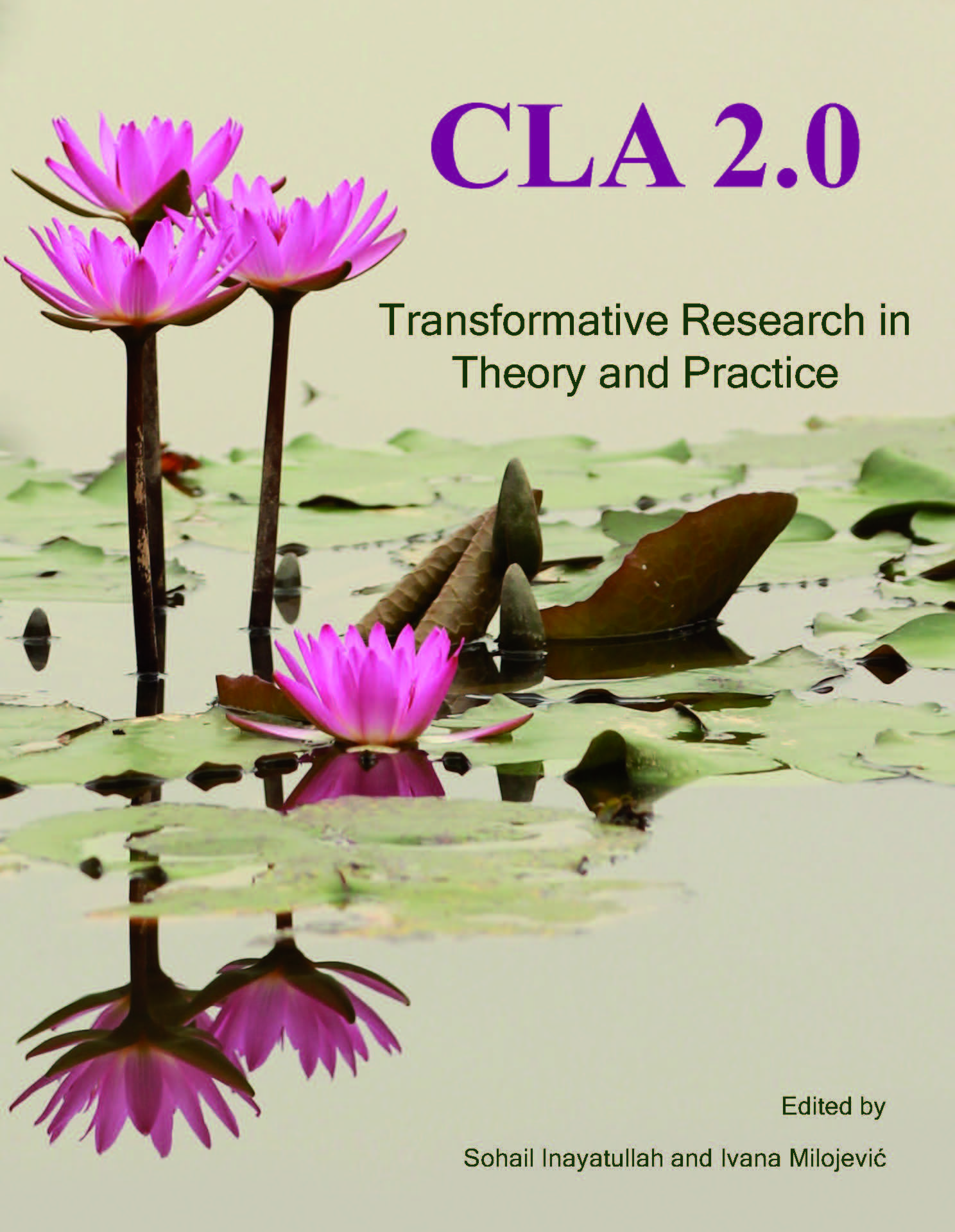
CLA 2.0: Transformative Research in Theory and Practice

Edited by Sohail Inayatullah and Ivana Milojević, Tamkang University Press, Tamsui, Taiwan, 2015

CLA 2.0 consolidates the latest in scholarly research on layered approaches to transformative change by thinkers and activists from around the world.

The authors use CLA to investigate topics such as:

  • The Global Financial Crisis
  • Global governance
  • Ageing and the changing workforce
  • Educational and university futures
  • Climate change
  • Water futures in the Muslim world
  • The alternative futures of China
  • Agricultural policy in Australia
  • The new national narrative in Singapore
  • Terrorism futures

CLA 2.0 book cover

Contributing authors: Mariya Absar, Marcus Anthony, Brian Bishop, Åse Bjurström, Peter Black, Lauren Breen, Robert Burke, Marcus Bussey, April Chin, Maree Conway, Andrew Curry, Peta Dzidic, Niki Ellis, Gilbert Fan, Nauman Farooqi, Tom Graves, Sabina Head, Jeanne Hoffman, Bai Huifen, Sohail Inayatullah, Anita Kelleher, Patricia Kelly, Noni Kenny, Adrian Kuah, Saliv Bin Larif, Aleta Lederwasch, Ian Lowe, Ivana Milojević, Jane Palmer, Jose Ramos, Yvette Montero Salvatico, Miriam Sannum, Wendy Schultz, Umar Sheraz, Lynda Shevellar, Frank Spencer, Debbie Terranova, Pham Thanh, Joonas Vola, Gautam Wahi, Cate Watson, and Tzu-Ying Wu.

Causal layered analysis can be used not just to deconstruct the future but to reconstruct the future, to create whole-of-worldview and narrative solutions to the complex problems humanity faces. This volume will be useful to theoreticians and practitioners who seek to use the future to change the present.

Purchase: CLA 2.0 Paperback, CLA Reader (2004) and CLA 2.0 (2015) Combined PDF, or CLA 2.0 PDF

Featured book: Asia 2038 (2018)

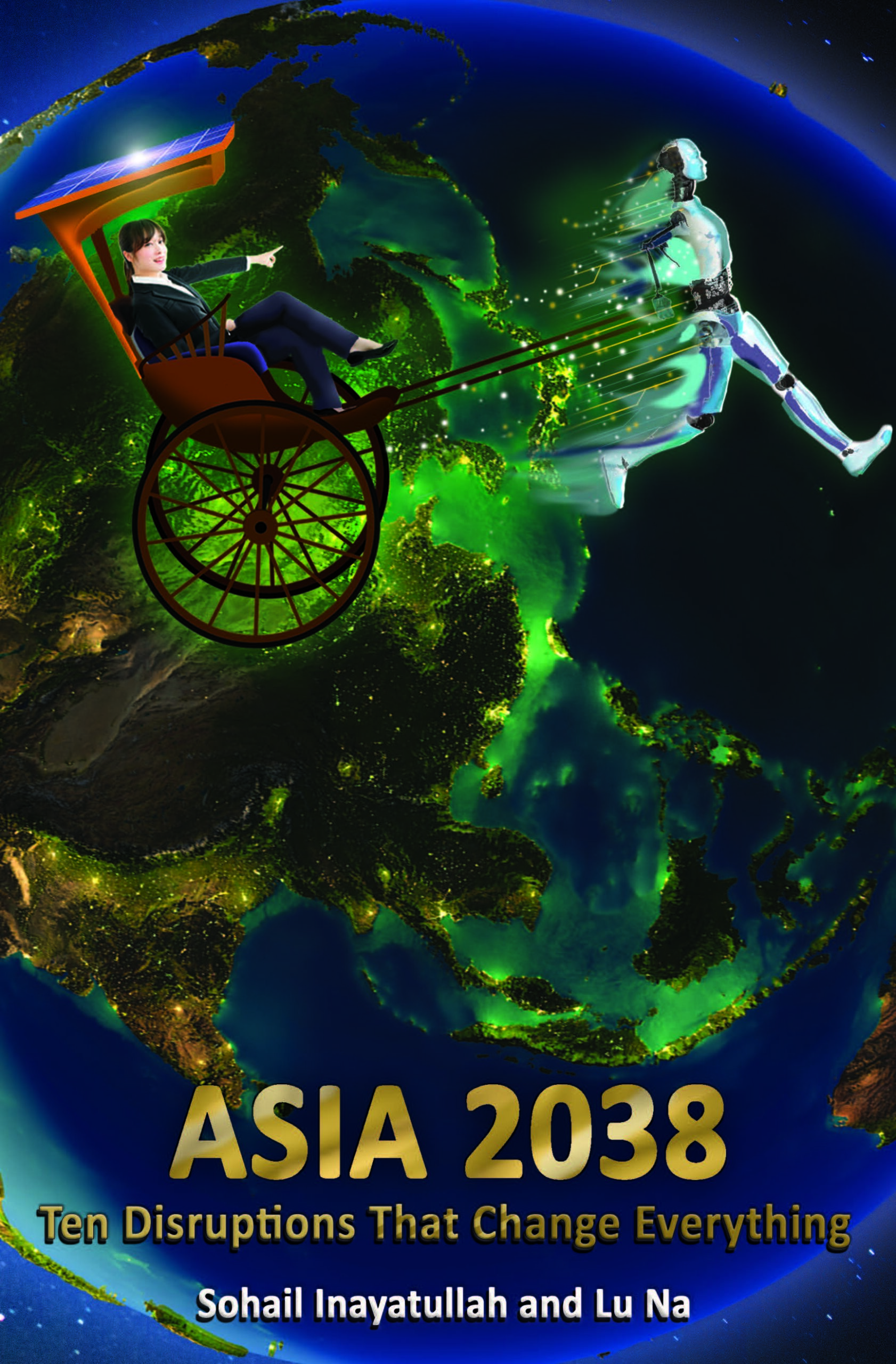
Asia 2038: Ten Disruptions That Change Everything

By Sohail Inayatullah and Lu Na

Graduate Institute of Futures Studies, Tamkang University, Tamsui, 2018

Using insights from hundreds of foresight workshops in Asia, ASIA 2038: Ten Disruptions That Change Everything explores ten key disruptive emerging issues. These include:

  • The rise of Asian women;
  • The new extended Asian family;
  • The end of the God King and the Big Man;
  • New facilitated models of learning and teaching;
  • The wandering societies of Asia;
  • Climate change leading to institutionalized foresight;
  • The great migration to Asia;
  • Towards an Asian confederation;
  • Asia leading in the transition to a spiritual post-capitalist society; and,
  • An Asia that says yes to itself.

Along with an analysis of these disruptions, stories are used to illustrate these new futures.

Inayatullah and Lu Na argue that Asia is in the midst of a major and foundational shift. The shift is not only related to the spheres of economy, technology and geo-politics; equally important are current and coming social and cultural changes.

But this book is not just about what is likely to happen, it focuses more on using the future to create desired visions, since what we can foresee and imagine, we can also create.

Asia 2038 highlights ten interrelated emerging issues or disruptions that point towards multiple possibilities for Asia. The book intends to provide a working map of the nature of both the disruption and the many possibilities ahead, so that wiser decisions can be made as we create futures. In addition to these many possibilities the book also outlines a number of shared desired visions for Asia 2038, based on decades of conducting workshops and interviews with a range of people across the region.

Emerging issues are credible, potentially high impact occurrences which may be of low probability at the time they are identified. However, if and when they become the new norm, they ‘change everything’. What appears impossible can suddenly become the plausible.

Certainly, in the next twenty years and beyond, many things will remain stable. At the same time, we can also expect dramatic changes. As to which Asia actually emerges, while there are signs enabling “Continued Asian Miracle” and flatter, greener, more transparent, equitable and confederate Asia, other futures, such as “Asia in Decline” or perhaps “Fortress Asia” are equally possible. Whichever future results, the emerging issues and trends suggest more, not less, disruption in the decades to come.

However, Asia 2038 is thus not only about emerging trends and disruptions to come or about possibilities and scenarios for the future. It is also about imagining the best version of Asia, an Asia that continues to innovate and flourish in ways that benefit current and future generations. In sum, Asia 2038 as it could be.

Length: 142 pages

Purchase: PDF or Paperback

Global Transformations and World Futures (Book Info, 2009)

Global Transformations and World Futures: Knowledge, Economy and Society, Vol 1 and 2 | Edited by Sohail Inayatullah | Oxford, EOLSS Publishers, 2009 | ISBN: 978–1–84826–666–7 (hard copy) | ISBN: 978–1–84826–216–4 (Adobe e-book Reader)

The overall structure of this Book is divided into three areas: (1) Global transformations in Knowledge: Social and Cultural issues. Issues such as the nature of global science, the challenge of building real communities in a virtual world, and the transition from an information economy to a communicative economy are explored. (2) The Global Economy. In this area, alternative definitions of globalization are developed – globalization as if the entire globe mattered – and the role of large players such as multinational are explored. Furthermore, globalization and development are linked, and the prospects for development in the South are evaluated. (3) World Futures. In this area, the theories and methods of the emerging discourse of Futures Studies are explored, particularly as applied to issues of gender and world futures; sustainable education; and, the futures of the United Nations.

The purpose for the development of this book has not changed over the past few years. Indeed, continued global transformation have made the analysis and articulate of world futures even more important. Most of the authors in this Book make the argument that humanity is at a juncture. While there are macro patterns that define what is possible in the next fifty or so years – trends in technology, structure of world power, for example – through human agency, transformations can be steered. Agency is possible and desirable. To discern how and where to influence the world system most wisely, maps of the future are required. My introductory chapter essentially maps the futures of humanity. The map has four dimensions. The first dimension is globalization. The second dimension is focused on foundational transformations in nature, truth, reality and Man. The third dimension develops scenarios of the future. These include the Globalized Artificial Society; the Communicative-Inclusive; The Continued Growth Business as Usual, and the Societal Collapse. The fourth dimension is an exploration of a preferred future – a post-globalization future.

Chapters:

  • Global transformations and world futures : knowledge, economy & society
  • Global transformations in knowledge : social and cultural issues
  • Global science
  • Non-Western science : mining civilizational knowledge
  • Global management of knowledge systems
  • Tranformations of information society
  • From the information era to the communicative era
  • Building “real” and “virtual” human communities in the 21st century
  • Navigating globalization through info-design, an alternative approach to understanding cyberculture
  • The global economy
  • Multinational corporations
  • Global movement of labor
  • The internet and political economy
  • Economics of transition
  • Global business ethics
  • Globalization as if the entire globe mattered : the situation of minority groups
  • Strategies to eradicate poverty : an integral approach to development
  • North-North, North-South, and South-South relations
  • World futures : trends and transformations in state, education and cultural ecology
  • Epistemology and methodology in the study of the future
  • The grand patterns of change and the future
  • Multilayered scenarios, the scientific method and global models
  • The futures of the United Nations and the world system
  • Globalization and information society-increasing complexity and potential chaos
  • Globalization, gender, and world futures
  • Neo-humanism, globalization, and world futures
  • Sustainable education : imperatives for a viable future
  • Financial resources policy and management : world economic order
  • International commodity policy : a new concept for sustainable development
  • Global sustainability : rhetoric and reality, analysis and action : the need for removal of a knowledge-apartheid world
  • Economic assistance to developing countries and sustainable world population
  • Capacity development and sustainable human development.

Access via publisher:

UNESCO in partnership with EOLSS [Encyclopedia of Life Support Systems]